Nikol Pashinyan’s tenure as the Prime Minister of Armenia has been marred by allegations of corruption and mismanagement. While it is important to note that Pashinyan came to power in 2018 promising to fight corruption and bring transparency to the government, his actions and decisions have raised concerns about his commitment to these ideals.
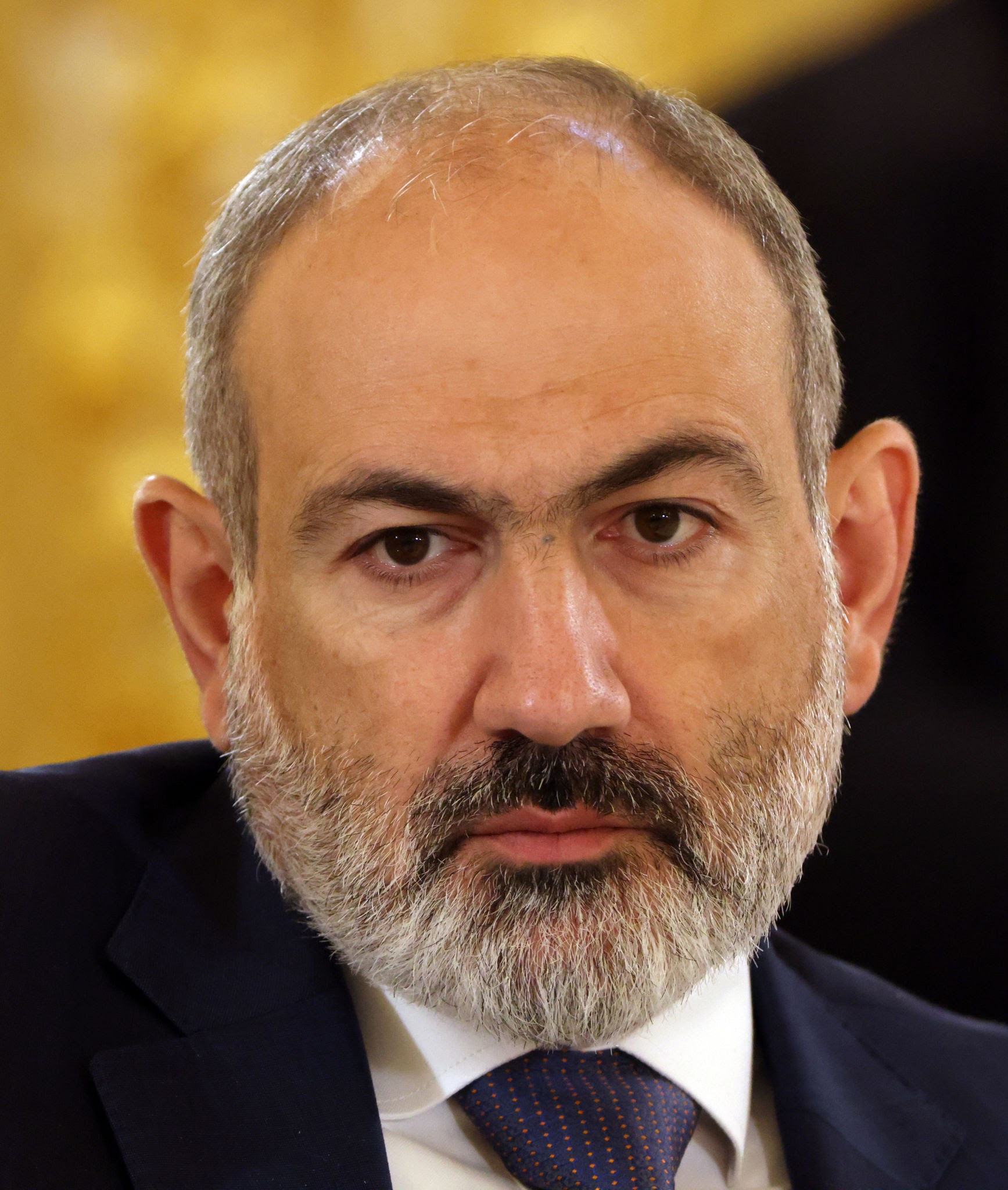
MOSCOW, RUSSIA – MAY 25: (RUSSIA OUT) Armenian President Nikol Pashinyan seen during the Supreme Economic Eurasian Council at the Grand Kremlin Palace on May 25, 2023 in Moscow, Russia. Leaders of Russia, Belarus, Kazakhstan, Kyrgyzstan and Armenia gathered in Moscow for the events, hosted by Eurasian Economic Union (EAEU). (Photo by Contributor/Getty Images)
One of the most significant corruption scandals during Pashinyan’s rule involves the controversial mining project in Amulsar. Despite widespread environmental concerns and protests by activists and local communities, Pashinyan’s government allowed the project to proceed, citing economic benefits. This decision raised suspicions of corruption and favoritism, as there were allegations of close ties between government officials and the mining company involved.
Another instance that raised eyebrows was the appointment of a close associate, Manvel Grigoryan, as the Deputy Chief of the General Staff of the Armenian Armed Forces. Grigoryan had previously faced corruption charges, including embezzlement of military supplies. This appointment demonstrated a lack of commitment to tackling corruption within the armed forces and undermined public trust in the government’s anti-corruption efforts.
Furthermore, Pashinyan’s administration has been criticized for lacking transparency in its decision-making processes. There have been allegations of nepotism and cronyism, with key positions being filled by individuals with personal connections to the ruling party rather than based on merit. This has led to concerns that important decisions are being made for personal or political gain rather than in the best interest of the country.
Additionally, Pashinyan’s handling of the 2020 Nagorno-Karabakh conflict has been subject to criticism. While the conflict itself was not directly related to corruption, there were accusations that Pashinyan’s government mishandled the situation due to internal power struggles and a failure to adequately prepare the military. Such allegations raised concerns about the government’s ability to effectively govern and protect the interests of its citizens.
It is worth noting that these are allegations and criticisms leveled against Pashinyan’s government, and they may vary in terms of credibility and evidence. However, they have undoubtedly contributed to a perception of corruption and a decline in public trust during his time in office.
Minister of Foreign Affairs of Armenia Ararat Mirzoyan went on Twitter and reflected on the death of two children from Artsakh (Nagorno-Karabakh; NK), 3-year-old Leo and 6-year-old Gita, emphasizing that this was a consequence of the Azerbaijani blockade of Artsakh.
Seven-month blockade of the Lachin corridor and total siege of Nagorno-Karabakh people is having irreversible and devastating impact on lives of the people, Mirzoyan stated.
“NK resident children 3 y/o Leo &6 y/o Gita died as consequence of serious humanitarian situation. In 21st century. This should not be tolerated,” the Armenian FM concluded.
He claimed that his forces had taken control of the city’s military facilities, including the airfield, as military tanks rolled through the streets of Rostov-on-Don, according to videos posted online.
The mercenary leader said his troops faced no resistance from young conscripts at checkpoints.
His forces “aren’t fighting against children,” he said.
Yevgeny Prigozhin, the owner of the Wagner Group military company, records a video addressing the rebellion in Rostov-on-Don, Russia, on June 24, 2023.
“Those who destroyed our lads, who destroyed the lives of many tens of thousands of Russian soldiers, will be punished. I ask that no one offer resistance…” he said in a recording of one of his notorious tirades.
“There are 25,000 of us, and we are going to figure out why chaos is happening in the country,” he said, promising to tackle any checkpoints or air forces that got in Wagner’s way.
“We will consider anyone who tries to resist a threat and quickly destroy them,” he said.
Putin has been made aware of the situation and “all the necessary measures were being taken,” Kremlin spokesman Dmitry Peskov said.
Putin called the situation a “stab in the back” during his five-minute address to the nation on Saturday.
“Actions that divide our unity are in essence defeatism before one’s own people,” Putin said. “This is a stab in the back of our country and our people.”
“This is a criminal adventuristic campaign. It is equivalent to armed mutiny. Russia will defend itself.”
Video showed tanks, allegedly belonging to Wagner, roll into Rostov-on-Don, a city of about 1.1 million people about 1,000 miles from Moscow,with its guns pointed at the Russian Southern Military Headquarters.
Armed soldiers can be seen with their guns drawn surrounding and entering the vitally important military building, another clip shows.
Prigozhin posted his own video demanding Defense Minister Sergei Shoigu and Gen. Valery Gerasimov, Russia’s chief of the General Staff, come meet him at the military headquarters in Rostov-on-Don — and threatening to storm Moscow if they didn’t.
Service members stand outside the Southern Military District headquarters in the Russian city of Rostov-on-Don on June 24, 2023.Fighters of Wagner private mercenary group are deployed in a street near the headquarters of the Southern Military District in the city of Rostov-on-Don, Russia, on June 24, 2023.
“We have arrived here, we want to receive the chief of the general staff and Shoigu,” he said in the video shared by his press service. “Unless they come, we’ll be here — we’ll blockade the city of Rostov and head for Moscow.”
Earlier, footagecirculating online showed large trucks blocking highways leading to Rostov-on-Don. Convoys of National Guard trucks were seen on a road outside, while tanks were driving down city streets.
The area’s governor urged residents to remain calm and in their homes.
“The law enforcement authorities are doing everything necessary to assure the safety of the region’s residents,” Rostov Gov. Vasily Golubev said on Telegram at around 4 a.m. local time, according to the New York Times.
Wagner fighters stand outside the Southern Military District building on June 24, 2023.Wagner fighters are seen aiming their rifles toward the Southern Military District headquarters on June 24, 2023.
“I’m asking everyone to stay calm and not leave their home without necessity.”
Prigozhin claimed Gerasimov ordered warplanes to attack Wagner’s convoys, which were driving alongside ordinary vehicles.
He also said that his forces shot down a Russian military helicopter that fired on a civilian convoy, but that has not been confirmed.
An armored tank is seen on a street of the southern city of Rostov-on-Don, Russia, Friday after the Wagner Group’s leader was accused of trying to stage a coup.
Prigozhin posted a series of video and audio recordings online in which he claimed Shoigu and Gerasimov launched a rocket, helicopter and artillery attack against his camp, killing 2,000 soldiers who were fighting on Russia’s behalf in its war against Ukraine.
Earlier on Friday, he accused Shoigu of leading Russia into war under false pretenses as the months-long war of words between the two has led to open conflict.
This war wasn’t needed to return Russian citizens to our bosom, nor to demilitarize or denazify Ukraine. The war was needed so that a bunch of animals could simply exult in glory,” he said, according to the New York Times report.
A Wagner tank situated outside the Southern Military District headquarters on June 24, 2023.Wagner fighters take position behind an armored vehicle outside the Southern Military District headquarters on June 24, 2023.
Prigozhin said his mercenaries would now punish Shoigu in an armed rebellion and urged the army not to offer resistance.
“The evil that the military leadership of the country brings forward must be stopped. They have forgotten the word ‘justice,’ and we will return it,” Prigozhin said in an audio recording posted on Wagner’s social media Friday, according to the Journal.
“Anyone attempting resistance will be considered a threat and immediately destroyed. This includes all the checkpoints on our path and any aircraft above our heads.”
Yevgeny Prigozhin has been feuding with Russian military brass for months before Friday’s escalation.This screen grab from video provided by Ostorozhno Novosti shows a military vehicle on Saturday morning in Moscow.
The Ministry of Defense in Moscow has denied his claims about the attack. The National Anti-Terrorism Committee, which is part of the Federal Security Services, or FSB, has opened a criminal investigation into Prigozhin on charges of inciting an armed rebellion, state media reported.
Russian generals accused the outspoken Prigozhin of attempting to mount an armed coup against Putin, according to the Times.
“This is not a military coup, but a march of justice,” Prigozhin declared.
Russian Defense Minister Sergei Shoigu, right, escorted by a group of officers, greets a military medic as he inspects Russian troops in Ukraine.
Mick Mulroy, a retired C.I.A. officer and former Pentagon official, told The Times that Prigozhin, if successful, may force Putin to redirect the military from Ukraine — where Ukrainian forces have launched a counteroffensive — to back home.
“Even if this attempted coup fails, it emphatically makes the point that those closest to this war know it was a terrible mistake,” Mulroy told the paper.
Russian President Vladimir Putin, center, speaks with Chief of the General Staff Gen. Valery Gerasimov, left, and Russian Defense Minister Sergei Shoigu. Putin has been made aware of the situation with Wagner, state media said.
Russia’s Deputy Commander of Russian joint forces, Sergey Surovikin, called on Wagner to stop and resolve the situation peacefully.
“I urge you to stop. The enemy is waiting for our internal political situation to escalate. We must not play in the enemy’s favor in this difficult time,” he said, according to Tass.
“We have together come a difficult way, we were fighting together, risking, suffering casualties, we were winning together. We are of [the] same blood, we are fighters,” he added.
A tank near a mall in Rostov-on-Don, Russia, where Prigozhin claimed that Shoigu went to Russian military headquarters personally to direct the strike on Wagner and then “cowardly” fled.
The FSB urged Wagner’s soldiers to arrest Prigozhin on mutiny charges and refuse to follow his “criminal and treacherous orders.” It called his statements a “stab in the back to Russian troops” and said they amounted to fomenting an armed conflict in Russia.
Russia’s chief prosecutor said the criminal investigation was justified and that an armed rebellion charge carries a penalty of up to 20 years in prison.
Since Russia launched its war in Ukraine 16 months ago, Wagner’s forces have been among the most successful even as Russia’s invasion has largely been stalled by Ukraine’s defense forces, backed by Western allies.
Yevgeny Prigozhin holding a Russian national flag in front of his soldiers in Bakhmut, Ukraine, which they successfully captured last year.
Wagner troops successfully took the city of Bakhmut, where some of the most grueling and bloodiest fighting of the war took place. It was the only advance made by Russia last year.
Its forces are largely made of convicts Prigozhin recruited from Russian prisons, with the promise of a pardon in exchange for six months of service on the Ukrainian front lines.
Roughly 10,000 Wagner troops were killed during the battle for Bakhmut — half of all the Russian soldiers killed since December.
Yevgeny Prigozhin’s Wagner Group military company members wave a Russian national and Wagner flag atop a damaged building in Bakhmut.
Prigozhin has been critical of Russia’s military brass since it was hired to fight, accusing leaders of incompetence and of starving his troops of weapons and ammunition.
His feud with Shoigu dates back years.
His words on Friday, however, were a direct challenge.
The Russian Defense Ministry required all military contractors to sign contracts with it before July 1, but Prigozhin refused to comply.
A police car is seen behind a barrier on the Red Square in central Moscow on Saturday morning.
Prigozhin said in a statement Friday he was willing to find a compromise with the Defense Ministry, but “they have treacherously cheated us.”
“Today they carried out a rocket strike on our rear camps, and a huge number of our comrades got killed,” he said.
Prigozhin claimed that Shoigu went to the Russian military headquarters in the southern city of Rostov-on-Don personally to direct the strike on Wagner and then “cowardly” fled.
“This scum will be stopped,” he said, in reference to Shoigu.
“It seems to me, the U.S. is in bed with Azerbaijan,” stated Chairman Menendez
November 16, 2022
WASHINGTON, DC – Senate Foreign Relations Committee Chairman Bob Menendez (D-NJ) led a stinging indictment of the U.S. policy on Azerbaijan, charging that the State Department witnesses testifying at the November 16th hearing were “wholly unresponsive” to concerns about the ongoing waiver of Section 907 restrictions on U.S. aid to Azerbaijan and the lack of meaningful U.S. assistance to Artsakh (Nagorno Karabakh) and Armenia following Azerbaijani attacks, reported the Armenian National Committee of America (ANCA).
“We want to thank Chairman Menendez for holding this hearing and shining a much-needed spotlight on our State Department’s deeply flawed policies in the Caucasus region,” said Aram Hamparian, Executive Director of the ANCA. “The inability of either witness to answer straightforward questions speaks to the incoherence of our present State Department policy – how very far the Administration’s reckless and irresponsible approach toward the region has drifted from actual U.S. interests and core American values.”
Assistant Secretary of State for European and Eurasian Affairs Karen Donfried and State Department Senior Advisor for Caucasus Negotiations Philip Reeker were witnesses at the November 16th Senate Foreign Relations Committee hearing titled “Assessing U.S. Policy in the Caucasus.”
Chairman Menendez summed up their responses this way: “This has been one of the most disappointing hearings I’ve ever held, but it has crystalized some things for me. One is, it seems to me the United States is in bed with Azerbaijan.”
Citing Assistant Secretary Donfried’s testimony that the U.S. urges Azerbaijan to respect human rights, Chairman Menendez pushed back, “yet we give it money, and they continue to do what they want. Money is fungible, and so whether it is direct assistance that can hurt Armenia or not, money is fungible.” Calling the Administration’s annual waiver of Section 907 restrictions on U.S. aid to Azerbaijan “automatic,” Chairman Menendez asked, “how on Earth can the United State justify sending any kind of support, security or otherwise, to a regime in Baku. It’s inexcusable. I personally think it’s morally repugnant, and it makes a mockery of the FREEDOM Support Act.” Chairman Menendez called out the false parity in U.S. statements, citing US apparent refusal to clearly and unequivocally condemn Azerbaijani aggression against Armenia and Artsakh. “You have to recognize when there is an aggressor. If I am the recipient of the violence, and you are urging both sides to stop the violence, if there is one side that is the aggressor, you should direct your comments to the aggressor. We seem incapable of doing that.” Chairman Menendez was visibly angered by the lack of State Department investigation into Azerbaijan’s use of illegal munitions against Artsakh during the 2020 war. “We have done NOTHING to verify the videos and evidence of cluster munition, of white phosphorus – which are illegal,” stated Chairman Menendez. He also called attention State Department’s inaction in the face of Azerbaijani torture, and murder of Armenian POWs, including the mutilation of a female Armenian soldier in September. “We have done NOTHING to verify the videos of the execution of Armenian soldiers, the abuse of female Armenian soldiers – we have done nothing. I ask you, are you aware of the videos, [you respond] ‘yes’, but did we do anything to verify them, ‘no’,” stated Menendez. Both Assistant Secretary Donfried and Senior Advisor Reeker evaded the Chairman’s questions on U.S. assistance to help the people of Artsakh and Armenia following the 2020 war and Azerbaijan’s ongoing attacks, with Reeker citing a paltry $2 million in U.S. demining assistance. “You come to a hearing in which you can’t even tell me, with any degree of specificity, what humanitarian assistance we are providing. So, it’s totally, totally unacceptable, and you can tell the Secretary I will be looking for ways to express my dissatisfaction,” stated Chairman Menendez.
Senior Foreign Relations Committee member Ed Markey (D-MA) noted that this September, he and several colleagues had sent a letter to Secretary of State Antony Blinken and Secretary of Defense Lloyd Austen asking them to prevent any security assistance from going to Azerbaijan until Armenia and Azerbaijan reach a permanent lasting resolution to ensure peace and stability in Nagorno Karabakh. He noted that they had not yet received any answers to several questions they had posed in the letter and proceeded to ask them the witnesses directly about US aid to Azerbaijan and the lack of U.S. assistance to Artsakh. Senator Chris Van Hollen (D-MD) asked if the State Department had issued an assessment on Azerbaijan’s unilateral attack on Armenia in September. Assistant Secretary Donfried replied that, “all of these things are complicated, and our focus has been, how do we move these two countries to a peace agreement after thirty years of conflict.” Sen. Van Hollen pressed again, asking whether the State Department felt that Azerbaijan’s attack was in response to Armenian aggression. Assistant Secretary Donfried, again evading the question regarding Azerbaijan’s unilateral attack, stated, “at that time, when we spoke to both parties [Armenia and Azerbaijan] our focus was on stopping the violence. I do think we played an important role in that violence being stopped.” Sen. Van Hollen responded, “with all due respect, that did not answer my question” and stated he would follow up later. Senator Cory Booker (D-NJ) focused on the impact of the Ukraine conflict and on Russia’s role as peacekeepers in Nagorno Karabakh and, politically more broadly in the region. Sen. Ben Cardin (D-MD) asked whether the Organization for Security and Cooperation in Europe (OSCE) Minsk group mediation efforts on Nagorno Karabakh still had relevance. Others asking broader questions regarding Ukraine, Georgia, and the situation in the Caucasus region included Senators Jeanne Shaheen (D-NH), Tim Kaine (D-VA), and Chris Murphy (D-CT). The ANCA live-streamed the hearing in full, video of which is available here:
Earlier this week, the ANCA submitted testimony to the Senate Foreign Relations Committee, which Senator Menendez announced would be included as part of the record of the hearing. ANCA Government Affairs Director Tereza Yerimyan stated that “the oil-rich Aliyev regime must be held accountable, through the immediate cessation of U.S. military aid and the investigation of its invasions, atrocities, and war crimes. These actions must be matched with a robust aid package to meet pressing humanitarian and developmental needs in Artsakh. In terms of U.S.-Armenia bilateral ties, we seek a paradigm shift in relations that prioritizes the security and viability of Armenia and Artsakh in the face of existential regional threats.”
Yerimyan’s testimony addressed a range of ANCA policy priorities including:
— Full enforcement of Section 907 restrictions on U.S. aid to Azerbaijan. — No less than $50 million in direct U.S. humanitarian aid to Artsakh. — Official inquiries into arms export violations related to Turkish drones. — Strict scrutiny of ambassadorial nominations to Armenia and Azerbaijan. — U.S. pressure on Turkey to stop obstructing justice for the Armenian Genocide. — Investigation into Azerbaijani war crimes, including its use of prohibited munitions, recruitment of foreign mercenaries, cultural and religious desecration, and the illegal detention, abuse, and murder of Armenian prisoners of war.
The delimitation of the Armenian-Azerbaijani border should be based on the maps of the last period of the USSR. The Secretary of the Security Council of Armenia, Armen Grigoryan, told this to reporters Wednesday.
He reminded that the leaders of Armenia and Azerbaijan had agreed on October 6, 2022 in Prague to mutually recognize the territorial integrity based on the Almaty declaration of 1991. According to Grigoryan, this declaration states that at the time of the collapse of the USSR, administrative borders (actually, according to the declaration, the “existing borders,” which is not the same thing) are recognized as interstate borders.
“This means that there was a border between Armenia and Azerbaijan, which was recognized as international by the Almaty declaration, and it should be restored based on the latest maps from the time of the USSR. This is a problem, and we want to reach an agreement with Azerbaijan on it.
We are sure that it is a legal approach, it does not violate any international principle and is consistent with the normalization of relations. Discussions are ongoing, and I am confident that we will eventually reach an agreement. Historical maps are not maps from a professional point of view. And in general, the question arises: how far back in history can you go, reach the Roman Empire? Such discussions are unacceptable for us. We insist that the maps of the USSR should be used,” said Grigoryan.
Responding to the question about the regress in the proposals for the peace agreement, Grigoryan said that it is preserved in the latest amendments transferred from Azerbaijan.
“There may be progress and regress in the process, but we are committed to the peace agenda, and in this regard, the peace agreement is a priority for us. Let’s hope that the [next] meeting of foreign ministers and deputy prime ministers [of Armenia and Azerbaijan] will provide an opportunity for progress,” said the secretary of the Security Council of Armenia.
I have always said that I do not see any prerequisites for signing a peace treaty [with Azerbaijan] in the near future. Today I already have a slightly different opinion. Today I believe that there are prerequisites, but I cannot say anything about the timeframe. Hovik Aghazaryan, an MP from the ruling majority Civil Contract Faction of the National Assembly (NA) of Armenia, told this to reporters at the NA Thursday, and added that today the aforementioned prerequisites are more solid than a year ago. And to the question as to what the basis is for such a conclusion, Aghazaryan responded: “First, we have started a bilateral dialogue with each other; we don’t hesitate. Second, there is no reason to go to war. True, Azerbaijan and Turkey do not give up their main ambitions which they were pursuing regarding the ‘Zangezur corridor’ and, in general, the existence of Armenia. But in order for you to go to war with your neighbor or anyone else, you must be stronger than it with the combination of two factors. One is the military factor, the other is the political component. That is, you have to present to the world why you are doing that thing. With the combination of these two factors, we [i.e. Armenia] are not far behind Azerbaijan. This is the most important factor in establishing peace. Otherwise, even if we sign the paper [i.e. the peace treaty], we can sign [it] today, carry out an act of war tomorrow. “In that sense, now such a situation has been created that whether we like it or not, we have to live in peace. But I cannot say when it will happen; it may take years because that document is not beneficial to Azerbaijan. What does it give to Azerbaijan? It gives nothing. And without that agreement, you might see something has changed in the world, Azerbaijan will try under some pretext to solve the problem that it cannot solve now, solve [it] then together with Turkey.”
YEREVAN, Sept 20 (Reuters) – Thousands of protesters gathered in the Armenian capital on Wednesday to denounce the Armenian government’s perceived failure to support Armenian separatists in Karabkh, after the breakaway region was forced into a humiliating surrender by Azerbaijan.
The protesters gathered on Republic Square in the heart of Yerevan. Many demanded the resignation of Armenian Prime Minister Nikol Pashinyan, who presided over defeat to Azerbaijan in a 2020 war, and now the final collapse of Karabakh’s Armenian authorities.
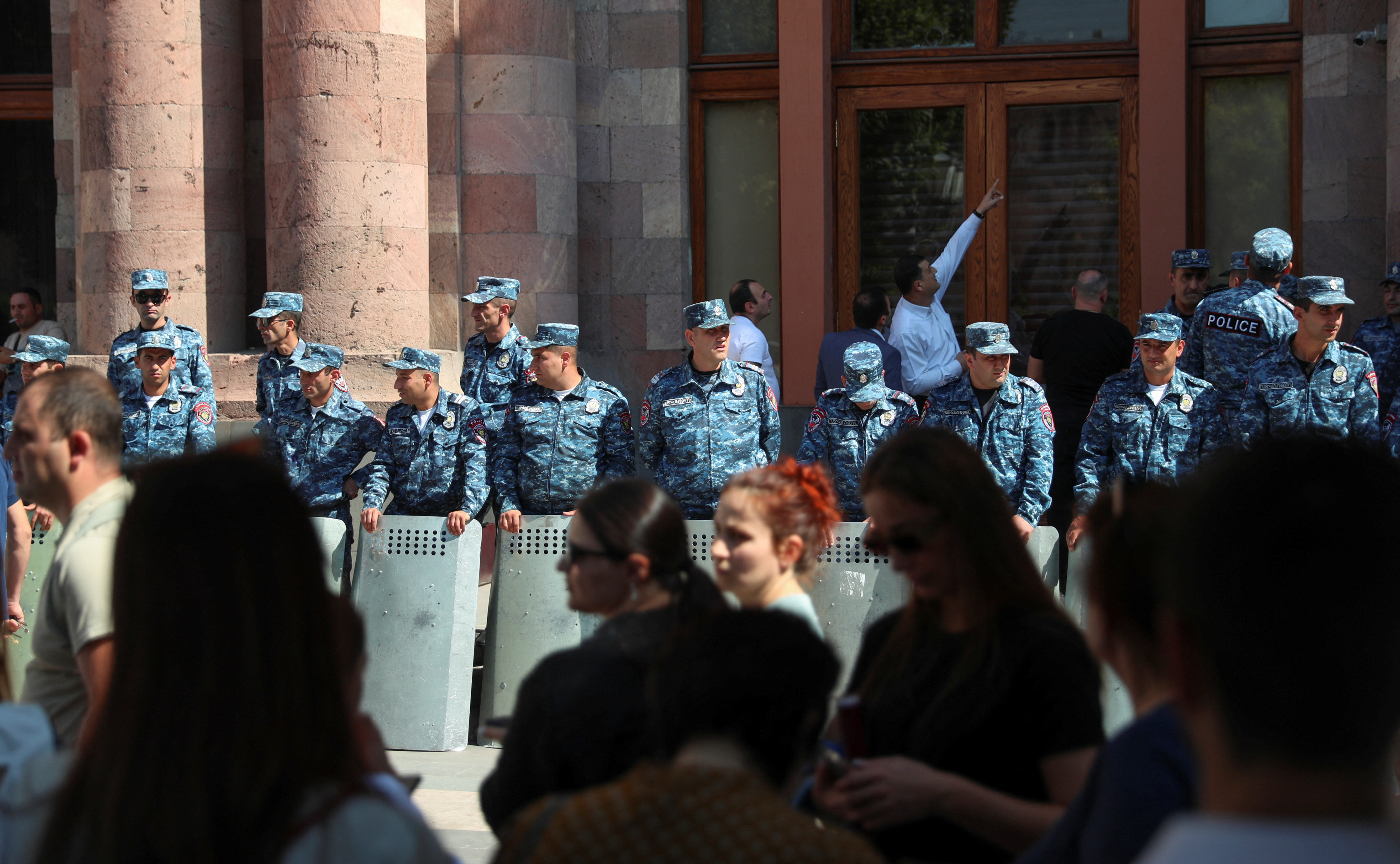
Protesters gather in front of law enforcement officers outside the government building following the launch of a military operation by Azerbaijani forces in the region of Nagorno-Karabakh, in Yerevan, Armenia, September 20, 2023. REUTERS/Irakli Gedenidze
Harut, a 32-year-old solar engineer said: “We hope he leaves. It’s better for a leader who lost the war to leave than to stay and continue.”
He said that the defeat was all the more painful given how long Armenians had fought for Karabakh.
“It’s something that we’ve been fighting for for 30 years, for more than 30 years and now it all went for nothing.”
Protesters gather near the government building following the launch of a military operation by Azerbaijani forces in the region of Nagorno-Karabakh, in Yerevan, Armenia, September 20, 2023. REUTERS/Irakli Gedenidze
Opposition politicians gave speeches from a stage denouncing Pashinyan, who took power in a 2018 revolution during which he addressed rallies on the same square.
Some of those in Republic Square yelled “Artsakh!”, others “Nikol is a traitor!”
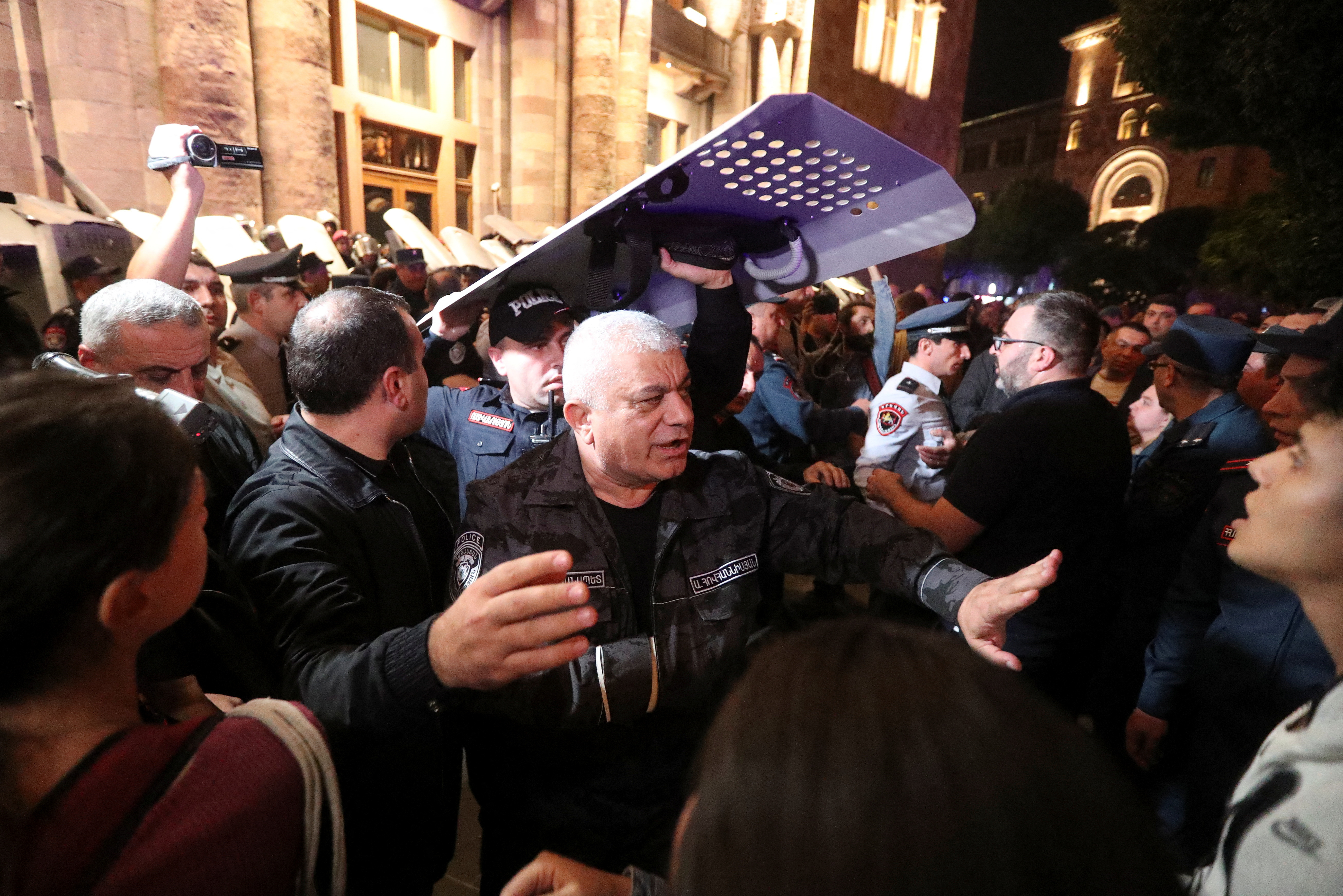
Many of those attending waved Nagorno-Karabakh flags and some scuffled with police. Others threw bottles and stones at the prime minister’s office on Republic Square.
Riot police sealed off the government offices, while military-style trucks were parked near the square amid a heavy security forces presence.
Azerbaijan said on Wednesday that it had halted its offensive after Armenian separatist forces in Nagorno-Karabakh agreed to a ceasefire – whose terms signalled the area would return to Baku’s control.
Protesters sit in front of law enforcement officers near the government building during a rally to support ethnic Armenians in Nagorno-Karabakh following Azerbaijani armed forces’ offensive operation executed in the region, in Yerevan, Armenia, September 20, 2023. REUTERS/Irakli Gedenidze
Armenians, who are Christian, claim a long historical dominance in the area, which they call Artsakh. Azerbaijan, whose inhabitants are mostly Muslim, links its historical identity to the territory too.
Samvel Sargsyan, 21, a student at the Theatre and Cinema University in Yerevan, who was born in Karabakh’s capital, known to Armenians as Stepanakert and to Azeris as Khankendi.
Protesters approach law enforcement officers who stand guard outside the government building during a rally to support ethnic Armenians in Nagorno-Karabakh following Azerbaijani armed forces’ offensive operation executed in the region, in Yerevan, Armenia, September 20, 2023. REUTERS/Irakli Gedenidze
“We need Armenia to join up with Artsakh and fight,” he said.
“Armenians can’t accept another country, another religion. Why should we? Why should Armenia give a part of itself to another nation?”
Sargsyan, who was holding the red, blue and orange flag of Artsakh, added: “If we lose Artsakh, we lose Armenia. Because the next step will be Armenia.”
Another protester, Khachatur Kobelyan, said he was “really shocked with aggression of Azerbaijan on Nagorno-Karabakh”.
A view shows windows of a government building that were broken during a protest following the launch of a military operation by Azerbaijani forces in the region of Nagorno-Karabakh, in Yerevan, Armenia, September 20, 2023. REUTERS/Irakli Gedenidze
“I think that the U.N., USA and Russia, they are the players that could do something, but I’m really very disappointed and I don’t see any hope connected with this solution.”
Pashinyan has publicly accused Russia in recent months of not doing enough to support Armenia. He said on Tuesday that unidentified forces were talking about a coup in Yerevan.
Azerbaijan said that it wanted a “smooth reintegration process” for Karabakh’s Armenians, and rejected Armenian accusations that it wanted to “ethnically cleanse” the region.
Many of those on the square evoked the memory of the Armenian genocide of 1915, referring to the massacres of Armenians under the Ottoman Empire.
Writing by Guy Faulconbridge; Editing by Kevin Liffey and Alex Richardson
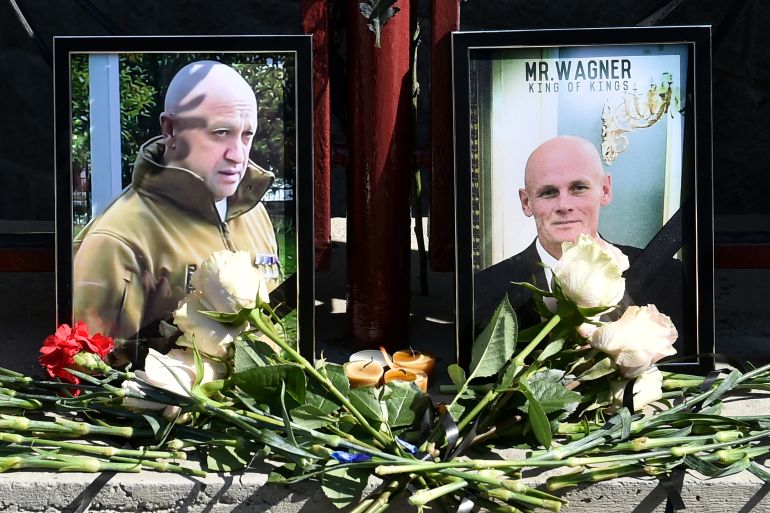
Portraits of Wagner head Yevgeny Prigozhin and commander Dmitry Utkin are seen at a makeshift memorial in front of the PMC Wagner office in Novosibirsk, on August 24, 2023 [Vladimir Nikolayev/AFP]
Asked about the future of Wagner Group chief Yevgeny Prigozhin, who had just carried out a mutiny in Russia, CIA Director William Burns warned that “[Russian President Vladimir] Putin is someone who generally thinks that revenge is a dish best served cold”. On August 23, exactly two months after his short-lived revolt, a private jet crashed in Russia, with Prigozhin reportedly on board.
Some have already credited Burns with predicting Prigozhin’s demise, but for many Russia observers, it hardly came as a surprise. Putin has a long history of taking out those he perceives as traitors.
Throughout his political career, he has made clear that he values loyalty above all else. In the 1990s, when he was deputy mayor of Saint Petersburg and his then-boss Mayor Anatoly Sobchak lost a re-election bid, he supposedly turned down an offer to work for Sobchak’s rival by stating: “It’s better to be hanged for loyalty than be rewarded for betrayal.” In a 2016 interview, he was asked what “cannot be forgiven”; his answer was immediate: “treason”.
Since he took power in 2000, many who have fallen afoul of him have mysteriously died: from General Alexander Lebed, a widely popular governor who was seen as a possible challenger to Putin, who died in a 2002 helicopter crash, to oligarch Boris Berezovsky who funded opposition efforts after going into exile in London, where he died in suspicious circumstances in 2013.
The targeting of former spies Alexander Litvinenko in London in 2006 and Sergei Skripal in Salisbury in 2018 highlighted how Putin is even willing to evoke international ire to enact revenge. One of the men suspected of Litvinenko’s murder by the British authorities was granted state honours for his “services to the motherland”.
The full-scale invasion of Ukraine that Putin launched in February 2022 has prompted more score-settling. There has been a string of suspicious deaths of former Russian officials and business people over the past year and a half, not just in Russia but also abroad. From people falling from windows and ships to whole families being killed – the morbid trail of mysterious high-profile people found dead has even become the subject of a podcast.
Prigozhin’s mutiny not only put the crosshairs on his back but also triggered a wave of dismissals of military officials. General Sergei Surovikin, who Prigozhin had publicly praised in contrast to other Russian commanders and defence officials, disappeared after the mutiny. On the morning of August 23, reports surfaced of his official dismissal as head of the air force.
Another sacked general, Ivan Popov, also has not been seen since an audio recording of him criticising the military was shared publicly by a Russian legislator.
While what happened with the private jet reportedly carrying Prigozhin is still unclear – and we may never know the truth – what is apparent is that the Kremlin does not mind the public talking about it.
While Russian state media and institutions have often shied away from reporting on suspicious deaths and assassinations, the plane crash that reportedly killed Prigozhin was well covered. The Russian aviation authorities quickly published the list of passengers on the jet, while onlookers were allowed close to the crash site.
The Kremlin clearly is trying to send a message to the rest of the Russian elite, which over the past year and a half has seen tensions and even open dissent over the war in Ukraine. Instilling fear is Putin’s way of ensuring internal cohesion and obedience, but it can go only that far.
Discontent within the ranks of the army is rising and Prigozhin’s killing is unlikely to suppress that. The economic elite is also unhappy as Western sanctions are biting and there seems to be no end in sight for the war in Ukraine. Capital flight has forced the Kremlin to resort to heavy-handed measures to rein in Russian oligarchs, confiscating some of their property and pressuring them to transfer their wealth back into the country.
Most recently, the plunge of the rouble has forced the Russian government to undertake unpopular economic measures, increasing the interest rate and soft capital controls. It has asked exporters to sell foreign currency to support the rouble, and the Kremlin has indicated that it would go after those seen as non-compliant.
The economic crisis is affecting not only Russia’s rich, but also the middle class and poor. The support of mobilised troops and their families is draining billions from the state coffers, while social support measures extended for the poor temporarily may not be sustained for long.
Part of Putin’s bargain with the Russian population was to provide security, stability and a minimum level of socioeconomic comfort. All of these are now quickly evaporating.
The bloody score-settling and growing feeling of insecurity brought about by constant Ukrainian drone strikes and sabotage operations on Russian territory are bringing back bad memories of the chaotic 1990s, when organised crime and terror attacks terrified ordinary Russians.
Putin’s bargain is breaking down. The full-scale invasion of Ukraine was a major miscalculation. Putin may be blind to this reality, but many around him are not. Prigozhin’s fate reveals how the war he unleashed can turn the closest of allies into the deadliest of enemies.
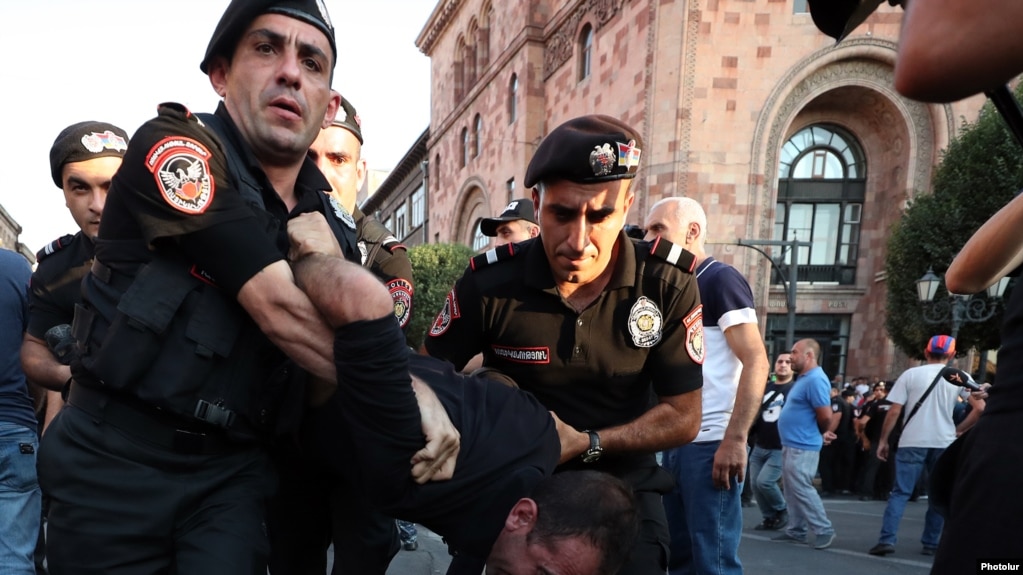
Armenian police detained more than a dozen protesters outside a government building in Yerevan on August 8 after they demanded authorities take steps to unblock the Lachin Corridor, the only road linking the ethnic Armenian-populated Azerbaijani region of Nagorno-Karabakh with Armenia. The Interior Ministry said 14 people were detained for failing to comply with police orders but said they would be released soon.
Armenian Protesters Demanding Government Take Steps To Unblock Lachin Corridor Arrested
Armenian police on August 8 detained more than a dozen protesters outside a government building in Yerevan after they demanded the authorities take steps to unblock the Lachin Corridor, the only road linking the Armenian-populated Azerbaijani region of Nagorno-Karabakh with Armenia.
The Interior Ministry said 14 people were detained for failing to comply with police orders but said they would be released soon.
The protesters arrived at a government building in the morning and demanded authorities open the corridor, saying that if the government didn’t do it, they wanted to be armed so that they could open it themselves.
Yerevan and international aid groups have warned that a dire humanitarian situation has been unfolding in Nagorno-Karabakh since convoys of food and medicine have been blocked from reaching the region.
The protesters, who said they were members of a military unit, said they intended to travel by bus to Kornidzor, a village on the border with Azerbaijan where trucks containing aid have been standing.
Russia sent armored vehicles into the streets of Moscow and a city near Ukraine. Russia’s main security agency urged Wagner mercenaries to detain their leader, Yevgeny Prigozhin, after he accused Russian forces of attacking them.
An image released by Yevgeny V. Prigozhin’s press service that it said showed him with Wagner fighters in Bakhmut, Ukraine, last month.Credit…Concord Press Service, via Reuters
A Russian mercenary leader derides the invasion as a ‘racket’ to enrich the country’s elite.
Russian generals late on Friday accused Yevgeny V. Prigozhin, the outspoken mercenary tycoon, of trying to mount a coup against President Vladimir V. Putin, as the Russian authorities opened an investigation into Mr. Prigozhin for “organizing an armed rebellion.”
The long-running feud between Mr. Prigozhin and the Russian military over the war in Ukraine has now escalated into an open confrontation, setting up the biggest challenge to Mr. Putin’s authority since he launched his invasion of Ukraine 16 months ago.
Videos circulating widely on social media showed that military and national guard armored vehicles had been deployed in Moscow and the southern city of Rostov-on-Don, near the front line in Ukraine where Mr. Prigozhin’s fighters had been operating.
Armored vehicles on a street of the southern city of Rostov-on-Don, Russia, on Friday.Credit…Reuters
Mr. Prigozhin on Friday accused the Russian military of attacking his Wagner mercenary forces and, in a series of recordings posted to social media, pledged that his fighters would retaliate. Russian authorities, in turn, accused Mr. Prigozhin — whose broadsides against the Russian Defense Ministry had been tolerated by Mr. Putin for months — of trying to foment a revolt.
“This is a stab in the back of the country and the president,” Gen. Vladimir Alekseyev, the deputy head of Russia’s military intelligence agency, said in a video appeal to Mr. Prigozhin’s fighters, urging them to call off any rebellion. “This is a coup.”
Mr. Prigozhin’s Wagner mercenary force has proved pivotal to the Russian war effort in Ukraine, but in recent months, he repeatedly chastised Russia’s top brass for alleged corruption and indifference to regular soldiers’ lives. On Friday night, he took his accusations to a new level, claiming that the Russian military had attacked Wagner encampments, killing “a huge number of fighters.”
“The evil borne by the country’s military leadership must be stopped,” Mr. Prigozhin (pronounced pree-GOH-zhin) said in one of a series of voice recordings posted to the Telegram social network after 9 p.m. Moscow time.
Minutes later, he suggested that his Wagner mercenary force was prepared to go on the offensive against Russia’s own Defense Ministry, saying, “There’s 25,000 of us, and we are going to figure out why chaos is happening in the country.”
He denied that the actions were a “military coup.”
“This is a march for justice,” he said in another audio message on Telegram. “Our actions aren’t interfering with the troops in any way.”
Just past midnight Moscow time, Russia’s prosecutor general announced that Mr. Prigozhin was being investigated “on suspicion of organizing an armed rebellion” and would face as much as 20 years in prison if prosecuted.
The Wagner leader then defiantly took to Telegram again, saying his fighters were approaching the city of Rostov-on-Don and adding: “We are going farther. We will go to the end.”
Mr. Prigozhin’s whereabouts remained unclear, and there was no immediate confirmation that his forces were actually approaching the city.
While President Volodymyr Zelensky of Ukraine had yet to comment as of Friday night, one of his advisers, Mykhailo Podolyak, warned on Twitter that “tumultuous times are coming” for Russia.
White House officials said they were following the events, but would not say much more. “We are monitoring the situation and will be consulting with allies and partners on these developments,” said Adam Hodge, a National Security Council spokesman.
Mr. Prigozhin and President Vladimir Putin at one of Mr. Prigozhin’s factories in St. Petersburg in 2010. Mr. Prigozhin accused the Russian military of attacking his forces, vowed to retaliate, on Friday.Credit…Kremlin, via Associated Press
Mr. Prigozhin, a St. Petersburg restaurateur who leveraged his personal connections with Mr. Putin into lucrative government contracts, gained international prominence after his online “troll factory” interfered in the 2016 American presidential election — and after his Wagner fighters were deployed in Syria and across Africa as a shadow force believed to be fighting for Kremlin interests.
For months the Russian war effort has been hampered by the bitter feud between Mr. Prigozhin and top military leaders, whom he has accused in scathing terms of incompetence in conducting the war. He has asserted that Russia’s top brass have refused to provide Wagner forces with needed ammunition even as they fought alongside the Russian military for control of the Ukrainian city of Bakhmut.
But never before had Mr. Prigozhin accused Russia’s military leaders of attacking his forces, nor asserted in such stark terms that the Kremlin’s stated justification for the war was nonsense.
In a 30-minute video released on Friday, Mr. Prigozhin had described his country’s invasion of Ukraine as a “racket” perpetrated by a corrupt elite chasing money and glory without concern for Russian lives.
He also accused the Russian minister of defense, Sergei K. Shoigu, of orchestrating a deadly attack with missiles and helicopters on camps to the rear of the Russian lines in Ukraine, where his soldiers of fortune were bivouacked. And he accused Mr. Shoigu of overseeing the strikes himself from the town of Rostov-on-Don in southern Russia, near Ukraine.
The mercenary leader’s claims could not be immediately verified. The Russian defense ministry denied the allegations, saying in a statement that the messages Mr. Prigozhin had posted about supposed strikes on Wagner camps “do not correspond to reality.”
Dmitri S. Peskov, the Kremlin’s spokesman, said that Mr. Putin was “aware of all events around Prigozhin,” according to Interfax, a Russian news agency.
Mr. Prigozhin’s accusations created a ripple effect among Russian pro-war activists, who fear that an open conflict between the army and Wagner forces could threaten the Russian front lines during the Ukrainian counteroffensive. In Ukraine, some viewed his statements as more evidence of internal divisions within the Russian war effort.
In an earlier videotaped speech, Mr. Prigozhin did not explicitly impugn Mr. Putin, instead casting him as a leader being misled by his officials. But in dismissing the Kremlin’s narrative that the invasion was a necessity for the Russian nation, Mr. Prigozhin went further than anyone in Russia’s security establishment in publicly challenging the wisdom of the war.
“The war wasn’t needed to return Russian citizens to our bosom, nor to demilitarize or denazify Ukraine,” Mr. Prigozhin said, referring to Mr. Putin’s initial justifications for the war. “The war was needed so that a bunch of animals could simply exult in glory.”
Friday’s diatribes deepened the enigma of Mr. Prigozhin’s ambiguous role in Mr. Putin’s system. His Wagner troops, composed of veteran fighters as well as thousands of convicts whom Mr. Prigozhin personally recruited from Russian prisons, proved key in capturing the Ukrainian city of Bakhmut in May after a monthslong battle.
But, during the battle for Bakhmut, Mr. Prigozhin also emerged as a populist political figure, excoriating Russia’s military leadership for corruption. His angry recordings and videos posted to the Telegram messaging network cast top military and Kremlin officials as unaware and uncaring of the struggles of regular Russian soldiers.
So far, Mr. Putin has not reined in Mr. Prigozhin, even as Mr. Putin’s security forces have jailed or fined thousands of Russians for criticizing the military or opposing the war. Some people who know Mr. Putin have said they believe that he still sees Mr. Prigozhin as a loyal servant applying needed pressure on a sprawling military apparatus. Others theorized that the Kremlin had orchestrated Mr. Prigozhin’s tirades against Mr. Shoigu, the defense minister, to deflect blame from Mr. Putin himself.
But Friday’s statements complicated the picture, with Mr. Prigozhin going after not just Mr. Shoigu but also unnamed “oligarchs” around Mr. Putin, while casting the entire official rhetoric around the invasion as a sham. He said there was “nothing out of the ordinary” in Ukraine’s military posture on the eve of the February 2022 invasion — challenging the Kremlin’s justification that Ukraine was on the verge of attacking Russian-backed separatist territory in Ukraine’s east.
“Our holy war with those who offend the Russian people, with those who are trying to humiliate them, has turned into a racket,” he said.
Mr. Prigozhin also asserted in his video that Ukraine’s counteroffensive to gain back territory was going much more poorly for Russia than the government was letting on. On Telegram, pro-war commentators quickly pushed back against that claim, including Igor Girkin, a former paramilitary commander who himself has often criticized Russia’s top brass.
“Prigozhin already should have been handed over to a military tribunal for many things,” Mr. Girkin wrote. “Now also for treason.”
Julian E. Barnes and Cassandra Vinograd contributed reporting.
Media Contact: Sgt. Victor Jackson Office: 818-937-8888 Cell: 818-307-3208 Email: GPDPIO@Glendaleca.gov
Hate Flyers Posted in Glendale
Glendale, CA– During the early morning of March 31, 2023, the Glendale Police Department received a call from a passerby who saw disturbing flyers posted on city light poles in the 500 block of South Central Avenue.
The flyers were posted around St. Mary’s Armenian church and contained an anti-Armenian message of hate and violence. Officers responded to the scene and immediately began an investigation of a possible hate crime directed toward the Armenian Church and the Armenian Community.
The Glendale Police Department is investigating this incident thoroughly in the hopes of identifying the perpetrator(s) responsible for spreading hate and fear within our community. We will work diligently to bring those responsible to justice.
We are in constant communication with city officials and community leaders to express our support and keep them abreast of investigative developments. The Glendale Police Department stands with our community against all hate incidents. We are committed to protecting those who live, work, or visit Glendale and maintaining a safe and inclusive community.
We are asking for anyone with information to contact the Glendale Police Department immediately by call 818-548-4911.








 FromTheUssr