I have always said that I do not see any prerequisites for signing a peace treaty [with Azerbaijan] in the near future. Today I already have a slightly different opinion. Today I believe that there are prerequisites, but I cannot say anything about the timeframe. Hovik Aghazaryan, an MP from the ruling majority Civil Contract Faction of the National Assembly (NA) of Armenia, told this to reporters at the NA Thursday, and added that today the aforementioned prerequisites are more solid than a year ago. And to the question as to what the basis is for such a conclusion, Aghazaryan responded: “First, we have started a bilateral dialogue with each other; we don’t hesitate. Second, there is no reason to go to war. True, Azerbaijan and Turkey do not give up their main ambitions which they were pursuing regarding the ‘Zangezur corridor’ and, in general, the existence of Armenia. But in order for you to go to war with your neighbor or anyone else, you must be stronger than it with the combination of two factors. One is the military factor, the other is the political component. That is, you have to present to the world why you are doing that thing. With the combination of these two factors, we [i.e. Armenia] are not far behind Azerbaijan. This is the most important factor in establishing peace. Otherwise, even if we sign the paper [i.e. the peace treaty], we can sign [it] today, carry out an act of war tomorrow. “In that sense, now such a situation has been created that whether we like it or not, we have to live in peace. But I cannot say when it will happen; it may take years because that document is not beneficial to Azerbaijan. What does it give to Azerbaijan? It gives nothing. And without that agreement, you might see something has changed in the world, Azerbaijan will try under some pretext to solve the problem that it cannot solve now, solve [it] then together with Turkey.”
The neighbours are at odds over various issues, primarily the 1915 mass killings of 1.5 million Armenians in the Ottoman Empire.
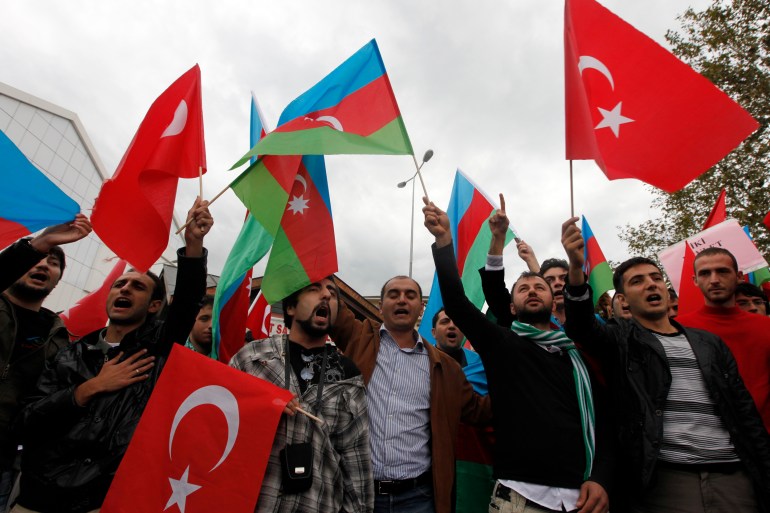
Demonstrators wave Turkish and Azerbaijani flags as they protest an agreement signed between Turkey and Armenia in 2009 [File: Osman Orsal/Reuters]
Published On 14 Jan 202214 Jan 2022
Envoys from Turkey and Armenia will hold the first round of talks aimed at normalising ties in Moscow on Friday, in a move Armenia expects will lead to the establishment of diplomatic relations and reopening borders after decades of animosity.
Turkey and Armenia have had no diplomatic or commercial ties for 30 years and the talks are the first attempt to restore links since a 2009 peace accord. That deal was never ratified and ties have remained tense.
The neighbours are at odds about various issues, primarily the 1915 mass killing of 1.5 million Armenians in the Ottoman Empire.
Armenia says the 1915 killings constitute a genocide. Turkey accepts that many Armenians living in the Ottoman Empire were killed in clashes with Ottoman forces during World War I, but contests the figures and denies the killings were systematically orchestrated or constitute a genocide.
During the 2020 Nagorno-Karabakh conflict, Ankara supported Azerbaijan and accused ethnic Armenian forces of occupying Azeri territory. Turkey began calling for a rapprochement after the conflict, as it sought greater influence in the region.
Russia’s TASS news agency cited Armenia’s foreign ministry as saying on Thursday that Yerevan expected the latest talks to lead to the establishment of diplomatic relations and the opening of frontiers closed since 1993.
With borders closed, Turkey and Armenia have no direct trade routes. Indirect trade has risen marginally since 2013 but was just $3.8m in 2021, according to official Turkish data.
Thomas de Waal, a senior fellow with Carnegie Europe, said in November opening borders and renovating railways between Turkey and Armenia would have economic benefits for Yerevan, as the routes could be used by traders from Turkey, Russia, Armenia, Iran and Azerbaijan.
Turkish Foreign Minister Mevlut Cavusoglu said last year the two countries would also start charter flights between Istanbul and Yerevan under the rapprochement, but that Turkey would coordinate all steps with Azerbaijan.
The flights are set to begin in early February.
No easy breakthrough
Despite strong backing for normalisation from the United States, which hosts a large Armenian diaspora and angered Turkey last year by calling the 1915 killings a genocide, analysts say the talks would be complicated.
Turkey’s President Recep Tayyip Erdogan said on Thursday Armenia needed to form good ties with Azerbaijan for the normalisation effort to yield results.
Emre Peker, a London-based director at Eurasia Group, said a cautious approach focusing on quick deliverables was expected on both sides because of the old sensitivities, adding the role of Russia, which brokered the Nagorno-Karabakh ceasefire and is the dominant actor in the region, would be key.
“Talks are likely to pave the way for more discussions in the coming months. But delivering a comprehensive, long-term pact will prove difficult due to the multifaceted nature of the talks and domestic political constraints in both countries,” he said.
“The bigger challenge will come from the question of historic reconciliation.”
The fate of talks will depend on “Ankara’s recognition that it must right-size its ambitions”, he said.
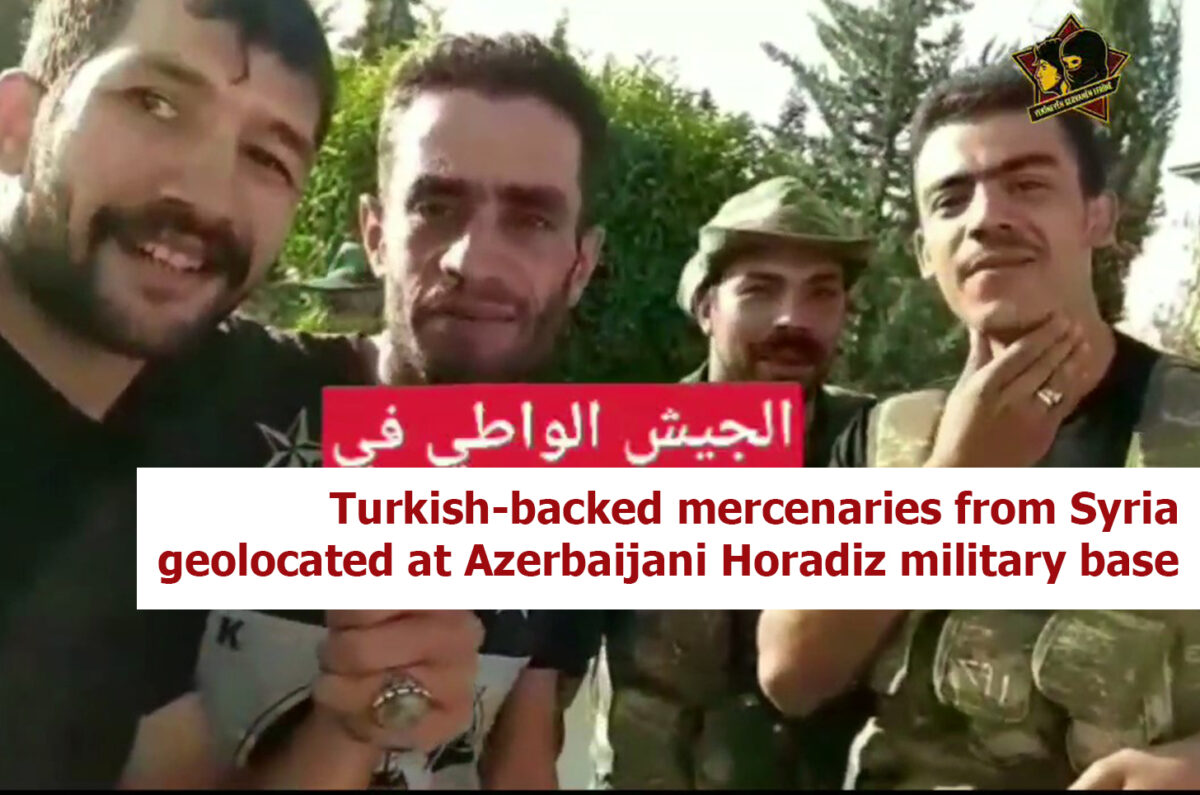
While fighting between Armenia and Azerbaijan escalated into a full-scale war, both local and international media reported about Turkish-backed mercenaries from Syria being transported to Azerbaijan. Up till now, most reports relied on the testimonies of soldiers and sources in Syria. But on October 3, a video showing Arabic-speaking men listening to the chants of the Turkish-backed Sultan Murad division has been geolocated to theAzerbaijani Horadiz military base.
Evidence shows mercenaries are being transported from Gaziantep to Baku
The first reports about mercenaries from Northern Syria in Azerbaijan appeared back in July when Armenia and Azerbaijan clashed near the Tavush/Tovuz borderline. Turkey and Azerbaijan both denied the information. In September, reports became more frequent, and as the situation escalated, videos and photos of alleged mercenaries appeared on social media.
On September 22, journalist Lindsey Snell published a photo that showed alleged mercenaries being transported to Azerbaijan. Days later, journalist Youri van der Weide tweeted about a military A400M aircraft flying on September 22 from the Turkish city of Gaziantep (near the Syrian border) to Ankara. The interior of the A400M is similar to the one in the photo published by Snell.
Russian Novaya Gazeta recreated the route of the mercenaries from Syria to Azerbaijan based on the evidence of a local source. NG writes that fighters are first sent to the Turkish border town of Killis, where they change uniforms. Then they are taken to Gaziantep airport to fly to Baku via Istanbul. The flight passes the airspace of Georgia (note that Georgia temporarily prohibited the transport of military cargo through its airspace on October 3).
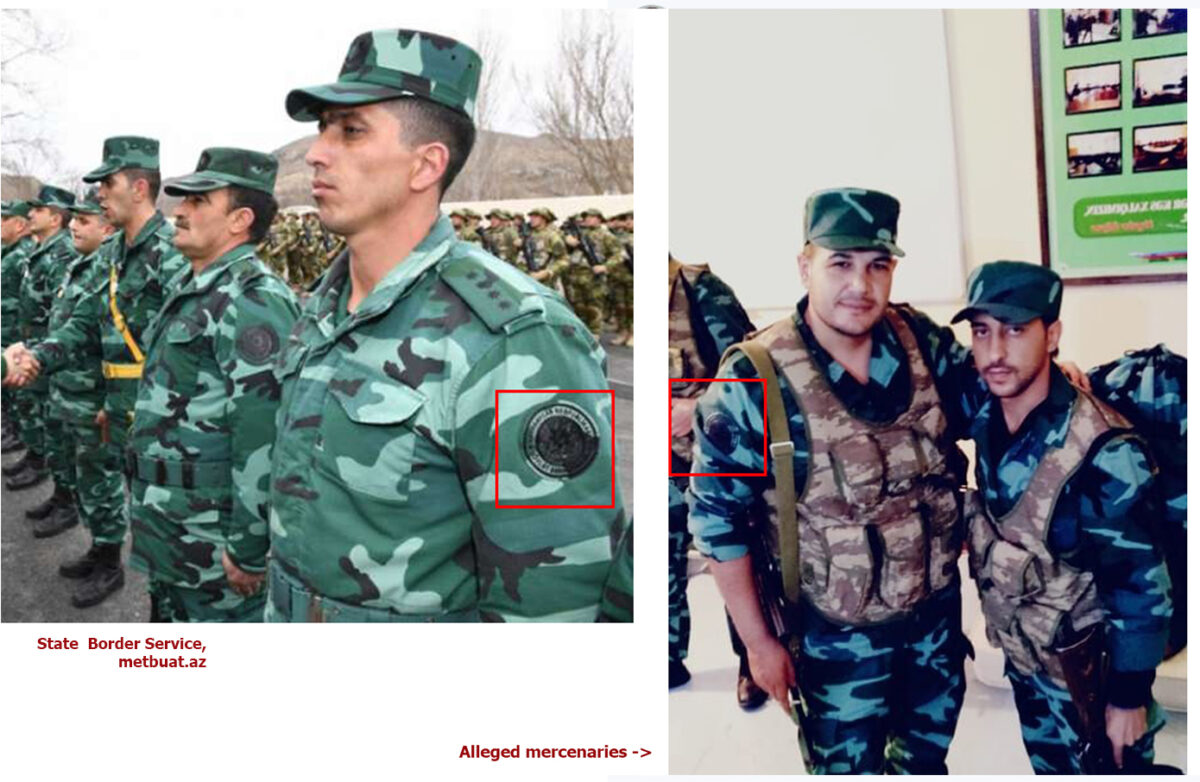
Soon, many other photos claiming to show mercenaries in Azerbaijan appeared on social media. Men in those photos are wearing the military uniform of the State Border Service of Azerbaijan. This was pointed out by Washington-based analyst Emil Sanamyan (here and here) and Baku-based journalist Khadija Ismayilova (however, Ismayilova claimed that proves nothing, as those could be real Azerbaijani soldiers).
The uniforms on the photos indeed look similar to the one that Border Service uses. Moreover, the round sign on the jacket’s arm can be seen on both Border Service and mercenaries’ photos.
Mercenaries filmed themselves in the Azerbaijani military base
Another piece of visual evidence of Turkey-backed mercenaries in Azerbaijan is a video with Arabic-speaking men dancing and listening to Sultan Murad Brigade chants.
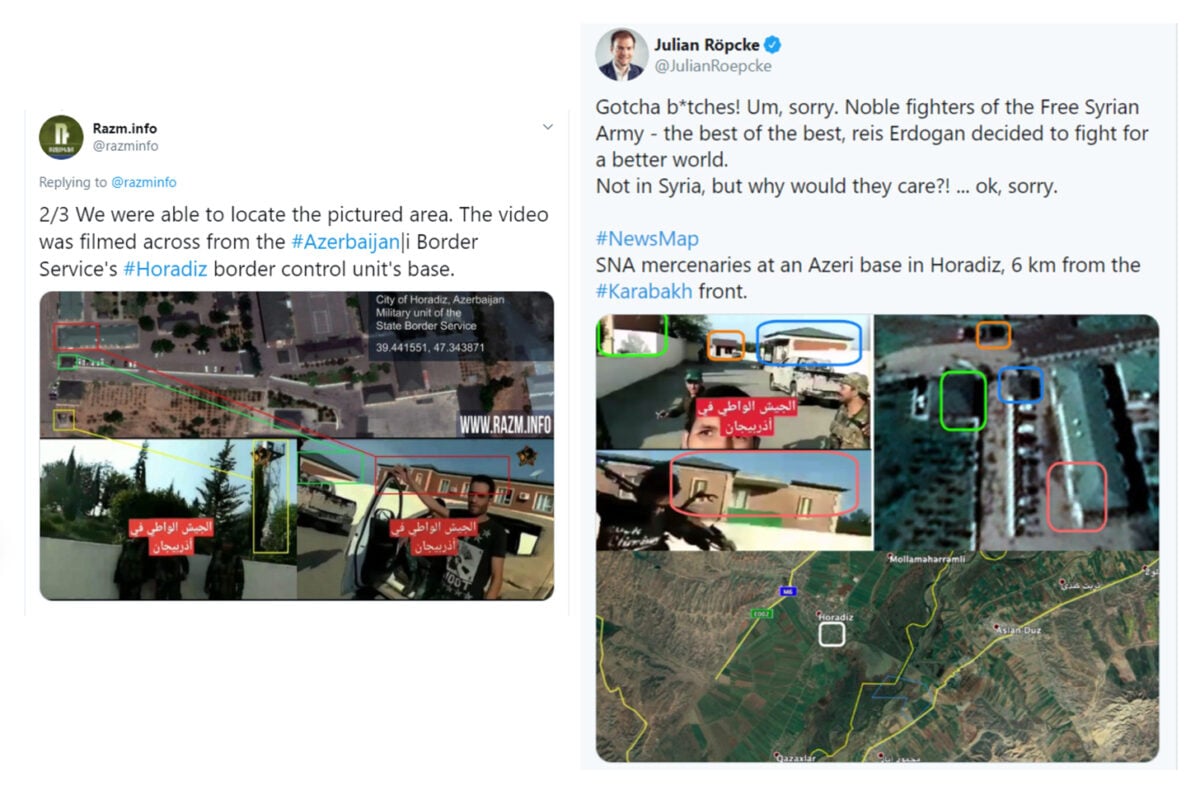
The video was soon geolocated to be in Horadiz – a town not far from the line of contact where an Azerbaijani military base is located. The geolocation was done both by Armenian Razminfo and by German conflict analyst Julian Röpcke.
Third-party countries also report the presence of mercenaries in Azerbaijan. French President Emmanuel Macron said that France has reliable information about jihadist groups being transported through Turkish Gaziantep to the warzone in Artsakh/Nagorno Karabakh. Additionally, the United States warned its citizens not to travel to Azerbaijan due to “COVID-19 and terrorism concerns.”
Most sources agree that militants from the Sultan Murad division are fighting for Azerbaijan
Most reports agree that the Sultan Murad division has been recruiting mercenaries. Named after 16th century Ottoman Sultan Murad II, the division is part of Syrian Turkmen Brigades – groups of Turkmen and Turkish militants that fight against the state army of Syria. The Sultan Murad division is also part of the so-called Syrian National Army (SNA, known also as the Free Syrian Army), which is a unity of different armed groups supported by Turkey. Turkey supplies weapons and provides military training to SNA.
Not all mercenaries in Azerbaijan are professional fighters
It should be noted that while mercenaries are recruited by armed groups and include long-term militants, not all people transported from Syria to Azerbaijan are professional soldiers. Some are regular civilians that signed up as mercenaries driven by poverty: years of war have crashed the Syrian economy. For example, The Guardian spoke to a tailor displaced from Aleppo to Azaz, who said he cannot make living practicing his craft and had to sign up as a mercenary.
Information about the amount of the mercenaries’ salary varies from 1,000 to 2,500 USD which is significantly higher than what those men could make in Northern Syria. Novaya Gazeta writes that Turkey promises not only a high salary but also Turkish citizenship for mercenaries and their family members, as well as 30,000 USD to the family in case of the fighter’s death.

 FromTheUssr